Training & Capacity Building focuses on strengthening the knowledge and skills required for sustainable water management. At Urdhvam, we design structured, science-based training programs for farmers, institutions, CSR teams, industries, and community stakeholders.
Our modules cover groundwater literacy, aquifer understanding, borewell monitoring, recharge planning, water budgeting, and pollution awareness. By combining technical expertise with practical, field-oriented learning, we enable participants to make informed decisions and take ownership of water resources. The outcome is self-reliant communities and organizations capable of managing groundwater responsibly and sustaining long-term environmental impact.
We assess stakeholder profiles, existing knowledge levels, local water challenges, and project objectives to identify specific training requirements.
Through consultations, surveys, and stakeholder meetings, we gather practical insights to tailor training modules to real ground conditions.
Based on assessment findings, we design structured training modules covering groundwater literacy, recharge planning, monitoring practices, and sustainable water management.
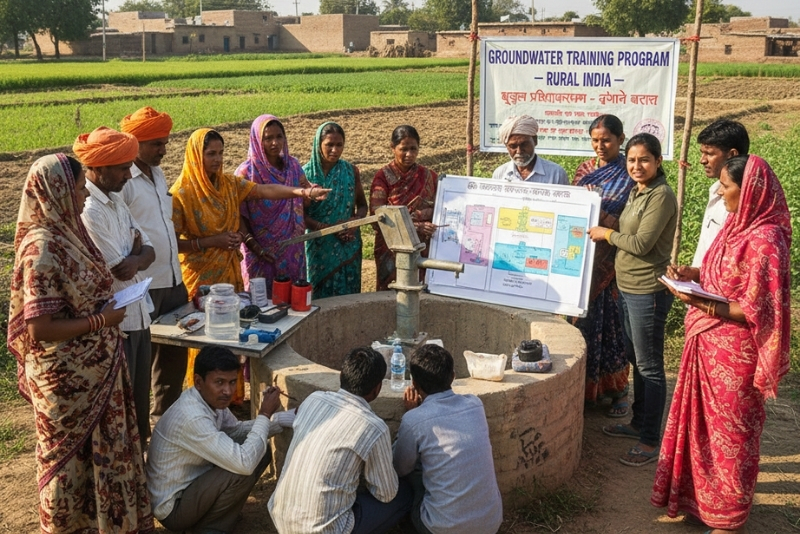
We conduct workshops, field demonstrations, and hands-on sessions, followed by feedback assessment and impact evaluation to ensure effective knowledge transfer.
It is a structured program designed to equip stakeholders with the knowledge and skills required to manage groundwater and water resources sustainably.
Farmers, Gram Panchayats, CSR teams, institutional staff, industry personnel, and development agencies can benefit from customized water management training.
Training modules typically include groundwater literacy, aquifer understanding, borewell monitoring, recharge planning, water budgeting, pollution awareness, and sustainable extraction practices.
The duration varies depending on objectives and audience, ranging from short workshops to structured multi-day capacity development programs.
Yes. Programs are tailored based on local water challenges, stakeholder needs, and project goals.
It enables informed decision-making, reduces dependency on external support, strengthens local ownership, and ensures sustainable water management practices.